In brief summation, Winsor’s “Communication Failures” is a examination of the public documents that have been released about the Challenger accident. The Challenger accident was a space shuttle launch failure that occured on January 28th, 1986 where all seven crew members died. Upon inspection, it was discovered that a long history of miscommunication had contributed to the tragedy. What is revealed in the artcile is how poor work dynamics can lead to disaster. The management and engineers that worked on the Challenger interpreted data differently because of their different positions in the project, and both parties had difficulties believing each other and sending bad news to superiors or outsiders. Knowledge about the miscommunication issues that led to the infamous Challenger accident is useful to engineers today and of the future to understand the significance of communication and to make sure proper communication standards are met in their own companies.

In this blog post I chose to focus on two specific excerpts from the text that particularly peaked my interest and that I felt were especially revealing and worth discussing.
The first piece I decided to look closely at was a letter from an engineer working on the challenger to the management above him:
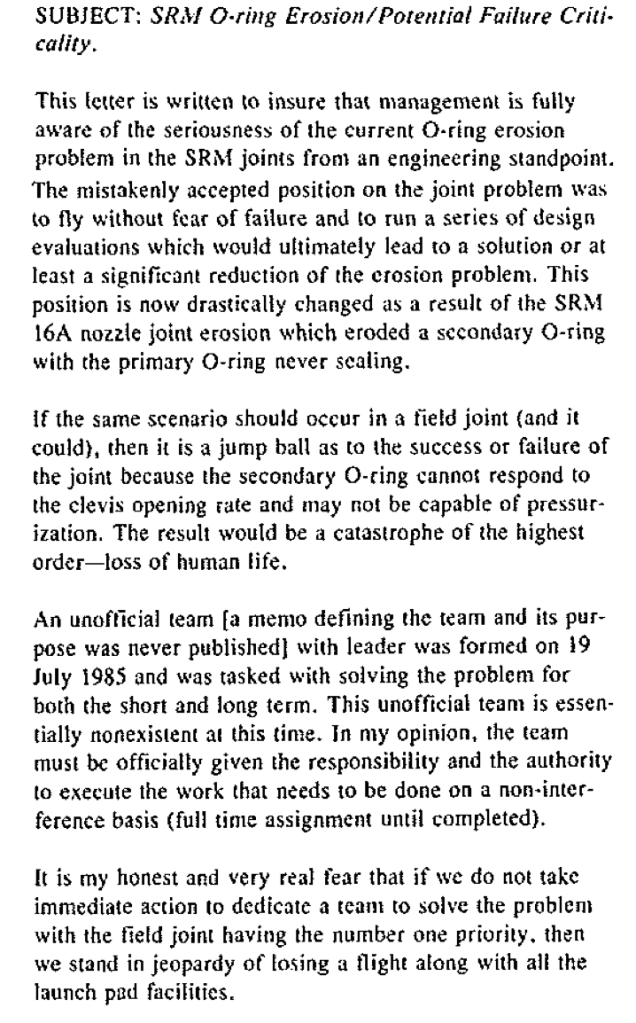
This excerpt is a letter from an engineer working on the Challenger to his management in which he addresses the potential failure of the O-ring, and reveals the urgency of the situation, along with his real belief that there could be catastrophic failure.
One of the key moments in this text that I noticed was that it was obvious that the engineer writing this letter was very aware of the danger and possible catastrophe of the Challenger launch. Which brings into question: With a letter like this, why was did the Challenger still launch? On one hand, the engineers and the management did not seem to be on the same page. An urgent letter from an engineer may not seem as significant to a manager coming from a different perspective and point of view. On the other hand, even if the management was aware of the problem, maybe they feared to report the bad news to the authority higher up above them.
Although it seems easy to fault the engineers or management heavily for not effectively conveying the significance of the O-ring problem, I cannot help but be sympathetic for the people who possibly feared for their jobs. However, by being a little selfish, the failure by the team working on the challenger to prevent the launch from happening is something that resulted in a catastrophe far worse than unemployment: human casualties. Therefore, I still personally believe that the fault should still lie with the engineers and management even though they were in a difficult situation. However, it is very difficult to shift the blame to any one specific person because overall it was a collective communication disaster.
My reaction to this piece was one of surprise, with a letter such as this, it was hard for me to fathom how the Challenger still proceeded to launch. Overall, this excerpt relates significantly to my field (Mechanical Engineering), and having read this, I feel like I better understand how a seemingly unimportant communication issue can have disastrous consequences.

 Golan's Lexicon